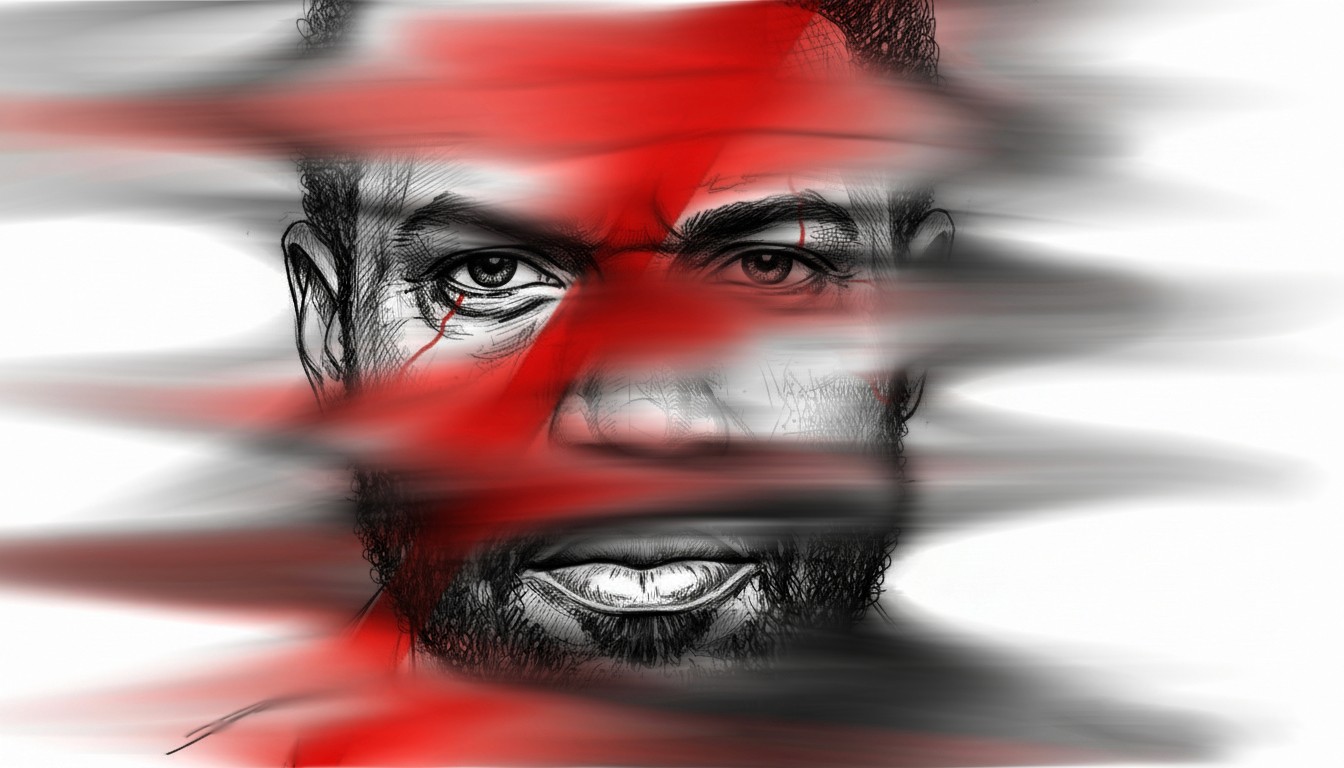
We are the architects of an inner landscape often drafted in the shadows of an unyielding past. For those raised in the 'Grey World' of 1970s Britain, the soul was not nurtured; it was contained within a 'box over the head'—a survival mechanism designed to muffle the daydream and brace for the slap. To reclaim the self, we must first recognise that the 'Voice of the Foreman' within is not a truth, but a somatic ghost haunting the machine.
Tuning the Narrator for Internal Sovereignty
The 1970s Legacy
The architecture of our inner world is often built upon the limitations of the time and place that raised us. For many who grew up in 1970s Britain—a landscape where the language of inner peace was absent—we learned to "carry restlessness quietly." This era left behind a specific personal artefact: the "box over the head."
This metaphorical box represents the containment of the soul, a survival mechanism developed in response to an environment that punished the "overindulgence of the daydream." Inside this box lives the conditioned nervous system, bracing for the "lightning crack of the slap" or the "phantom fingers" of discipline even when no threat is present.
In this vacuum of spiritual tools, the internal narrative is often commandeered by the "Voice of the Foreman." This voice is the psychic equivalent of the "grey men"—figures who inhabit towering structures of power and move through their days "consumed by worry" without a glimmer of joy. The Foreman is the enforcer of the "grey routines we inherit." He speaks in the language of "troubling reports" and "supposed uselessness," demanding conformity to a world that views imagination not as a gift, but as a defect to be corrected.
Identifying the Grinding Voice
To reclaim the self, the NARRATOR—our conscious awareness or Master Node—must learn to identify when the inner voice is no longer speaking truth, but is merely a symptom of an Unanchored Frequency. This unanchored state is a condition where the mind is agitated by external pressures rather than grounded in internal reality.
The Foreman’s frequency is not merely a collection of negative thoughts; it is a somatic misfire. Drawing on Antonio Damasio’s Somatic Marker Hypothesis, we can identify the Foreman as a Maladaptive Somatic Marker. In a regulated system, a pulse-spike is simply biological data—an engine revving in response to a task. However, in a system conditioned by the "box over the head," the brain misinterprets this neutral somatic signal. It translates the rapid "thump-thump" of the heart not as energy or focus, but as the imminent "threat of a slap."
The Foreman is the narrator who steps into that split-second gap between the body’s signal and the mind’s awareness, hijacking the biological pulse to enforce a script of fear. When the internal monologue insists on separation ("I am a freak," "I am poor"), the Narrator must recognise this as the grinding noise of a machine running without oil—a spirit trying to operate without its connection to the "vast joy of the Spirit."
Re-Boring the Narrative
Once the grinding voice is identified, the task is to "re-bore" the narrative tunnel, tuning the Narrator away from the Foreman and toward the Internal Teacher. This begins with a deliberate act of Sensory Gating.
As noted in the Mind Mechanism methodology, "Closing our eyes removes us from the projection of material and jolts us into presentness." In a clinical context, this is a strategic interruption of high-bandwidth visual data. By shutting down the visual feed of the "grey masses"—the distracting, often threatening stimuli of the external environment—we immediately lower the Linguistic Cost of regulation. For the neurodivergent or EAL learner, the brain’s "processing fuel" is often exhausted by simply navigating the sensory whirlwind. When we gate the senses, we reclaim that energy, clearing a frictionless path for the Narrator to access the "Tokens" of the 400+ Node Taxonomy.
The re-boring process requires actively overwriting the Foreman's script with specific "prayers, positive thoughts, and reflections." The story of Sam provides the blueprint for this shift. He moves from the Foreman’s narrative of his "supposed uselessness" to the Internal Teacher’s affirmation: “I am calm. I am peaceful.” This is not passive wishful thinking; it is the construction of a sanctuary of tranquillity where the noise of the world cannot reach.
Finally, we stabilise this new frequency through visualisation. When the Foreman tries to crush the spirit with the weight of the world, the Internal Teacher instructs us to "free your mind from your body's weight." We adopt the stance of Emma, listening to the heartbeat not as a panic signal, but as "an engine pushing a plough through thick mud." In this state, the Narrator realises that the "box over the head" was never a prison, but a doorway waiting to be opened. We are no longer the "casualties of social poverty"; we are cherished, free to belong to everything, and glowing with a light that has always known how to return home.
The 'box over the head' was never intended to be a permanent residence; it was a temporary shelter that we mistook for a cell. By gating the sensory whirlwind and re-tuning the Narrator to the frequency of the Internal Teacher, we dismantle the Foreman’s towers of worry. We emerge no longer as casualties of a grey era, but as sovereign entities—free to belong to everything, finally listening to the heartbeat not as a warning, but as the rhythmic return to a home that has always been ours.